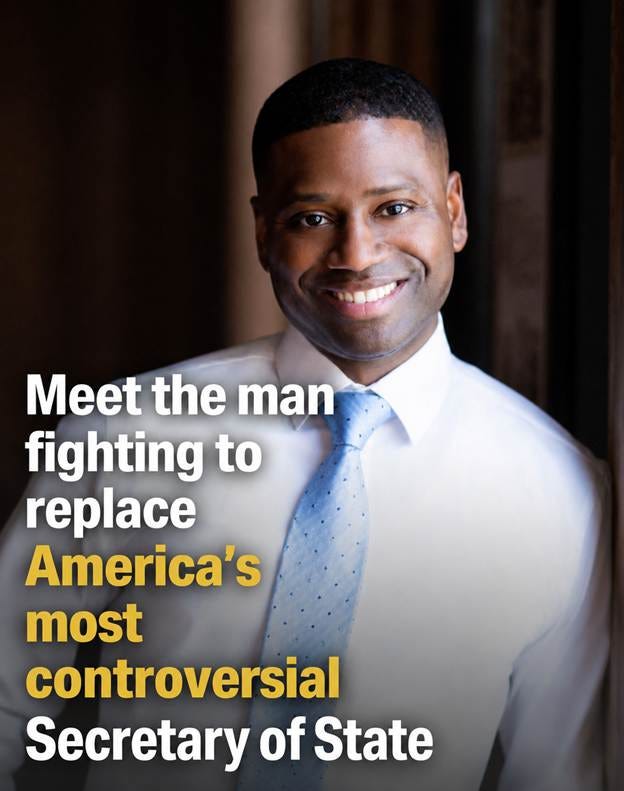
Meet the Man Fighting to Replace America's Most Controversial Secretary of State

Thanks to all of my donors for supporting independent journalism, research, and allowing me to create free educational content venmo myranda-kazos
Monae Johnson campaigned on the idea that South Dakota’s elections were threatened by fraud. Four years later, the biggest election controversies of her tenure have come not from fraudulent voters—but from the office she leads.
Since becoming South Dakota’s Secretary of State in late 2022, Monae Johnson has presided over a series of administrative mistakes, election disputes, and self-inflicted controversies that would likely dominate headlines in larger or more politically competitive states. Instead, they have unfolded largely outside the national spotlight, shielded by one-party rule and a media market too small to command sustained national attention.
Johnson assumed office on December 5, 2022, after former Secretary of State Steve Barnett resigned before the end of his term. Governor Kristi Noem appointed Johnson to fill the vacancy following her victory in the Republican primary, and she was formally sworn into the office the following January.
Conspiracy Theories
Much of Monae Johnson’s appeal to Gov. Kristi Noem and South Dakota’s Republican establishment stemmed from her embrace of election-denial narratives popularized after the 2020 presidential election. Those claims, amplified by figures such as Mike Lindell, became more than political rhetoric. Across the country, they evolved into a powerful fundraising tool and a litmus test of loyalty to Donald Trump.
Johnson did not campaign as a traditional election administrator. She campaigned as an election-integrity activist, repeatedly questioning the administration of the 2020 election and advocating expanded post-election audits despite the absence of evidence that widespread fraud affected South Dakota’s election results. Those positions helped her defeat incumbent Secretary of State Steve Barnett at the Republican convention and became the defining message of her campaign.
Once in office, Johnson continued emphasizing election audits and procedural changes under the banner of restoring confidence in elections. Supporters viewed those efforts as necessary safeguards. Critics argued they legitimized doubts about elections that South Dakota officials had never demonstrated were compromised.
What is striking, however, is that many of the most consequential election controversies during Johnson’s tenure have had little to do with the voter-fraud scenarios that dominated her campaign.
Instead, they have involved the less glamorous—but far more important—work of administering elections: inaccurate voter-registration records, ballot-access disputes, delayed absentee ballots, and the mistaken disclosure of sensitive voter information. These were not allegations of sophisticated conspiracies. They were administrative failures.
That contrast matters. Conspiracy theories often flourish by filling gaps in understanding with assumptions of hidden intent. Complex election systems inevitably produce mistakes, but mistakes are not, by themselves, evidence of fraud. The responsibility of a secretary of state is to distinguish between the two—to understand how the system works well enough to identify genuine vulnerabilities without manufacturing new ones.
Johnson frequently described some early problems as part of a learning curve or attributed them to administrative rules and longstanding procedures. But voters do not elect a secretary of state to learn the job after taking office. As Democratic challenger Terrance Davis has argued, this is not a position where the public should accept “learn as you go” governance.
Ironically, the record suggests that the most significant threats to confidence in South Dakota’s elections during Johnson’s tenure did not come from the conspiracies she warned about. They came from preventable administrative errors within the office entrusted with protecting the integrity of the state’s elections.
Those concerns extend to the state’s voter role themselves. Public records continue to show examples of outdated registrations remaining active long after individuals have moved. For example, former Deputy Director of ICE Madison Sheahan continues to appear on South Dakota’s voter rolls despite being registered elsewhere, while another individual who previously resided at the same address reportedly remains registered there years after relocating. Those examples do not, standing alone, establish illegal voting. They do, however, illustrate the persistent maintenance problems that election officials themselves are responsible for addressing.
Since taking office, nearly every major election cycle overseen by Johnson has generated significant administrative controversy. Taken individually, each incident might be dismissed as an isolated mistake. Viewed together, they suggest a broader pattern of management that deserves far greater public scrutiny than it has received.
Voting Down in Every South Dakota County 2024
On Nov. 1, 2024—just four days before Election Day—a Microsoft Azure outage crippled South Dakota’s TotalVote voter check-in system. County auditors were told to fall back on paper records, a contingency state law already requires. Some counties transitioned without issue. Others did not. Voters reported being turned away, instructed to cast provisional ballots, or waiting hours to vote on one of the busiest days of the election. For an administration that built its reputation on protecting election integrity, the problem was not a conspiracy. It was preparedness.
Failure to Advise Candidates and Place them on Ballots
In 2024, Republican House candidate Carson Merkwan was told by the Secretary of State’s office that he needed 39 valid signatures to qualify for the Republican primary.
That advice turned out to be incorrect.
The law actually required 50 valid signatures.
Merkwan submitted his petitions relying on the number provided by the Secretary of State’s office. After challenged signatures were removed, he fell below the actual legal threshold and was ruled ineligible to appear on the Republican primary ballot. A judge acknowledged that the misinformation came from the Secretary of State’s office but held that the statutory requirements still controlled, meaning Merkwan could not remain on the ballot as a Republican candidate. He still had the option of running as an independent in the general election.
Violation of Privacy
In 2025, the Secretary of State’s Office released South Dakota’s statewide voter-registration database containing information identifying thousands of voters who had registered through public assistance agencies. Voting-rights advocates argued the disclosure exposed information protected by federal law because it revealed how certain citizens registered to vote. Johnson accepted responsibility, removed the data, and notified affected voters, but the episode raised broader questions about whether the state’s chief election official had adequately safeguarded sensitive voter information.
Months later, Johnson’s office entered negotiations with the U.S. Department of Justice over a proposed voter-roll maintenance agreement. Voting-rights organizations and the Democratic National Committee warned that portions of the proposal could conflict with the National Voter Registration Act by increasing the risk that eligible voters could be removed before receiving adequate notice or an opportunity to correct errors. Johnson rejected those concerns, arguing that maintaining accurate voter rolls is a core responsibility of her office, though the state ultimately declined to finalize the agreement after negotiations broke down.
Then came the 2026 primary.
An Election Without Ballots
State law requires absentee voting to begin forty-six days before Election Day. Instead, ballots in several counties were not ready when voting was scheduled to begin, forcing county auditors to explain delays to voters while Johnson’s office advised counties to temporarily rely on sample ballots. Johnson attributed the delays to an unusually compressed election calendar and a record number of candidate filings. Critics countered that anticipating those challenges was precisely the responsibility of the state’s chief election officer.
The Irony
Perhaps the greatest irony of Johnson’s tenure came only weeks after South Dakota’s delayed-ballot controversy.
After years of campaigning on election fraud, one of the state’s most significant recent election-fraud prosecutions did not involve the sweeping conspiracies that dominated political rhetoric. Instead, Republican state Sen. Thomas Pischke surrendered to authorities after being charged with felony offenses alleging he knowingly submitted falsified nomination documents for Republican precinct positions. Pischke has pleaded not guilty, and the charges remain pending.
Standing alone, any one of the controversies outlined in this article could be dismissed as an isolated mistake. Together, they reveal a different pattern. The defining election issues during Johnson’s tenure were not widespread voter fraud or coordinated election conspiracies. They involved delayed ballots, ballot-access disputes, voter-roll maintenance, the release of sensitive voter information, candidate filing errors, and the day-to-day administration of the state’s election system.
For an office that campaigned on restoring confidence in elections, the greatest challenges ultimately came from administering them.
Rejected by Her Own Party
Perhaps the clearest political verdict on Johnson’s tenure came not from Democrats or voting-rights organizations, but from the Republican delegates who first elevated her to statewide office.
Johnson became secretary of state after defeating incumbent Steve Barnett at the 2022 Republican convention, propelled by delegates who wanted a more aggressive approach to election integrity following the 2020 presidential election. Four years later, those same delegates declined to nominate her for another term.
Instead, Republicans selected state Rep. Heather Baxter as their nominee for secretary of state. Incumbent constitutional officers are rarely denied renomination in South Dakota, particularly within a party that has dominated statewide politics for decades. Whatever motivated individual delegates—whether dissatisfaction with administrative performance, disagreement over election policy, or a desire for different leadership—the outcome itself was significant. The coalition that brought Johnson to office chose to move in another direction.
That fact does not, by itself, determine whether voters should support or oppose Johnson in November. But it should prompt an obvious question: if even her own party concluded new leadership was needed, should the rest of the state ask the same question?
A New Way Forward
The Secretary of State should rarely make headlines.
It is not an office designed for partisan combat or political celebrity. Its responsibilities are straightforward but essential: administer elections competently, safeguard public records, oversee business filings, and ensure that every eligible voter can participate in a process that is fair, accurate, and transparent.
When that work is done well, most people never notice it.
During Johnson’s tenure, however, the office repeatedly became the story. Administrative errors overshadowed the conspiracies that dominated campaign speeches. Questions about ballot access, election administration, voter privacy, and public confidence replaced promises of restoring trust.
That is why I am supporting Terrance Davis.
I do not expect to agree with every decision he would make as secretary of state. That is not the standard I apply to public office. The standard is competence, transparency, accountability, and a demonstrated commitment to administering elections fairly for every South Dakotan, regardless of political affiliation.
Healthy democracies depend on competitive elections—not only for public office, but for ideas. For too long, South Dakota has treated many statewide races as foregone conclusions. Accountability requires meaningful competition, and meaningful competition gives voters the opportunity to evaluate records rather than rely on party labels.
This election is not simply about Republicans and Democrats. It is about whether the office responsible for protecting South Dakota’s elections has earned another term.
After reviewing Monae Johnson’s record, I do not believe it has.
That is why I believe South Dakotans should elect Terrance Davis as their next Secretary of State.
To make a contribution to Davis’ Campaign: https://davisforsouthdakota.com/
To check voter registration in South Dakota: https://vip.sdsos.gov/
To become a South Dakota resident and registered voter for federal elections, even you are not from South Dakota:
https://americasmailbox.com/
605-718-1234